Learning the Language: Life Beyond the Origin Story of Brain Body Bold
I was born in 1984, and I remember that squeaky cart of the 90s with the big TV the teacher would bring in that signaled a break for us all. For me, I didn't have to deal with the "interrogation lighting," also known as overhead UV lighting. Other kids were just happy to have a nap, and teachers, no judgment, got a well-deserved break and a chance to catch up on grading. For me, this also meant that we would watch Lorenzo's Oil. It was one of the most common choices unless it was a video adaptation of an assigned novel. I saw Lorenzo's Oil three times growing up. Around that time, I also saw Stargate. Both have a distinct moment where they discuss language, and I think it shaped who I would become.

In Stargate, James Spader comes in and looks at a translation on a chalkboard. He quips at the methodology used and does his own translation, coining the term "Stargate" in the process. Meanwhile, in Lorenzo's Oil, the parents are struggling to support their son who has a genetic condition causing the body to attack the myelin sheaths of his neurons. The husband makes a speech about learning from their past experiences living in other countries: "We should treat Lorenzo's illness like another country. We studied, we got to know the language, resources, its law. So, in order to understand it, we need to command genetics, biochemistry, microbiology, neurology, ology-ology." One linguistic discovery led to adventure and my love of science fiction. Both were a love letter to stubbornness, which I have in spades.

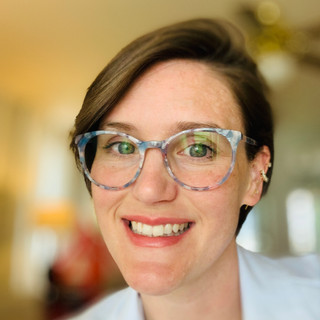
Fast forward, when I was in undergrad, I thought I would be a physician, likely a neurologist. And about the moment I had clarity in what I wanted, life decided to take a turn. I developed every manner of headache, cluster, tension, and migraine. My skin was so irritated it was splitting open on my hands. I felt horrible when I ate, frequently fainted, and for extra fun, my blood pressure would dip to 70s/30s on a semi-weekly basis. This was me.
I look like just another college student, probably stressed but healthy looking with a bit of dark circles. It was just a few months after this photo that I had a seizure. Every test was normal. This picture was taken just a few months before I had my first seizure.
I was already learning the language of biology and chemistry, so after a fortuitous meeting with a functional medicine physician, not mainstream at all in those years, I decided to learn the language of inflammation. I started peeling back the layers: undiagnosed allergies and food sensitivities, a mutation that meant I didn't clear histamine well, MTHFR, a cortisol curve so inverted my body thought it was being chased by a tiger every evening. I addressed those, and the headaches went away. The migraines went away. The digestive issues, the allergies, the fainting, all of it, it all melted away.
That was the moment the plan to become a neurologist quietly rewrote itself. If tackling inflammation could do that much for me, what if all I did for other people was help lower inflammation, take care of pain, ease a bit of stress? What a lovely profession. So I enrolled in graduate school for Chinese medicine, and completed a functional medicine program alongside it, because by then I'd learned enough to know I wanted both languages, not just one. Then, in my last term of school, life brought the same lesson back around, this time for someone else. We welcomed our son into the world, and during a very long delivery, he had a large stroke. My first patient after graduation was my own son.
I saw those same blank faces from when I was the patient along with a recommendation: 20 hours of speech and occupational therapies per week. This is exceedingly expensive for parents, one, but two, at the time and still to date, I know of no profession that is given 20 hours a week with now endpoint to show results. I want to be clear that I value OT and ST enormously; they are wonderful, necessary professions, and Logan has benefited from every one of them. But at the time, it left me looking for what else might be missing. The experts seemed to know a lot about the pathology, but very little about how to heal his brain. I became obsessed with people who were trying to heal the un-healable. I was learning a language. As part of my doctoral work with AOMA, I went back to UT and dug more into biochemistry. I actually I ended up a couple classes short of another degree in biochemistry.
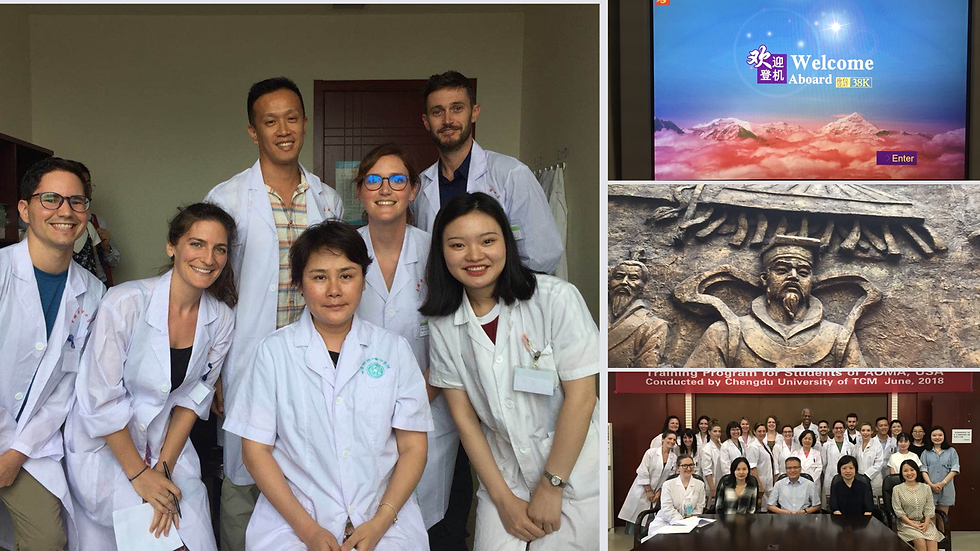
I studied with Dr. Song Luo and investigated the trainings offered by Dr. Terry Wahls and Dr. Daniel Amen. Then, I did an immersion program in Chengdu, spending most of my time in their neurology department.

As Logan grew, he started struggling with milestones, and the fist on his affected side became more and more noticeable. Showing dominance on one side in infancy and holding a constant fist are early manifestations. What happens is the fist begins to develop hypertrophy while the arm is held lax and bent, leading to atrophy. The go-to is a splint and occupational therapy. I started acupuncture instead. After his first treatment, he grabbed my face with slobbery hands. After a moment of "oh god, that's so much spit," I realized he was grabbing my face with both hands.
Dr. Song Luo was one of my mentors in school, a neurologist from Chengdu. (He's now practicing with the Cleveland Clinic.) He taught me how to approach treatment, and most importantly, how to integrate activity. Where the go-to was a splint for the affected hand, I splinted the unaffected hand after acupuncture, to get him using his affected side. I'd even chase him a little and hide in the pantry, so he had to use his hand to open the door. For his affected leg, the issue was organizational, not motor. He didn't want to crawl, but he'd scoot to the stairs and try to climb. After a moment of being the helicopter mom, I realized climbing the stairs was helping him organize his movements, and that organization was what let him crawl. So we did acupuncture, then stair climbing. He started crawling. I got a baby gate. From there, he showed great progress.

To date, he has full use of his affected side. He plays catch with my husband in the living room, arm outstretched, palm flat, holding the paddle, and throws with his left.
He is nonverbal, and I've learned so much from that language exploration into sensory processing that it could probably be its own post. People ask me often how he's doing, and how I'm doing. We're great, thanks to a whole-system approach and some genuinely great practitioners, including a speech therapist who utilizes an approach total communication.
Looking back, the thread running through all of it is really just one method, applied over and over to whatever was in front of me: understand the system, identify the targets, explore the therapies, observe what happens, and be open to what the observation tells you, even when it contradicts what you were taught to do. That's what got me from "every test is normal" to my own diagnosis. It's what got Logan from a fisted hand to a flat palm catching a ball.
He still has challenges, but we get it figured out. We learn the language.
(... yes, this is also why I have a million certificates.)
Comments